
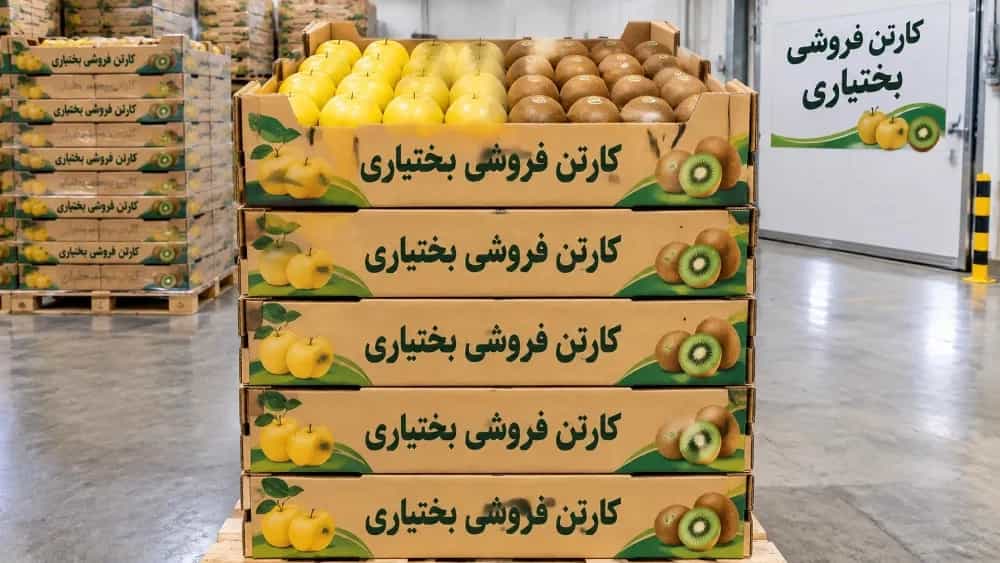
Purchasing fruit cartons at an economical price requires accurate matching of the paper weight and the number of layers (3 or 5 layers) with the net weight of the cargo and the transit route. The cheapest choice is not necessarily the lowest primary factor, but packaging whose edge crush resistance (ECT) prevents the product from falling in price due to crushing in transit. Direct and unmediated procurement from the manufacturer, choosing kraft sheets with suitable flutes and ordering in standard pallet dimensions are the three main conditions for a definite reduction in the finished cost of the fruit carton.
The difference between 3-layer and 5-layer cartons in bearing weight and transportation shock
In the operational calculations of the packaging of agricultural products, the weight of the product on the scale is not the only criterion; The dynamic pressures of the roads and the vibration of the truck determine the thickness of the carton. 3-layer cartons (including two liner layers and one middle flute layer) are usually economically justified for products weighing up to 6-8 kg, such as strawberries, nectarines, and peaches in short urban routes or daily delivery to Tarebar Square. The lighter weight of these cartons reduces the initial shipping cost and has good flexibility in quick arrangement.
On the other hand, export loads, cold storage loads and heavy citrus fruits such as oranges and apples weighing more than 10 to 20 kg definitely need 5-layer sheet. The 5-layer sheet consists of two flute layers and three liner layers. Our direct experience in examining returns of fruit shipments shows that the use of 3-layer cartons for a shipment that remains in the cold room for more than 7 days increases the risk of pallet collapse by 65%. Therefore, the savings of buying cheaper cartons in this sector will directly lead to the destruction of the load.
Also, the type of composition of flutes plays a decisive role. The combination of B and C flutes (so-called BC flutes) is the most widely used formula for producing 5-layer fruit cartons; Because flute B has a high surface resistance against perforation, and flute C assumes the property of shock absorption and maintaining the air cushion.
Specifications of suitable cardboard for cold storage and fruit humidification
The biggest physical enemy of the carton in the fruit supply chain is the breathing humidity of the product itself and the air of cold storages above zero. Conventional cardboards made from recycled waste paper (weak test liners or low-quality pseudo-krafts) quickly absorb moisture from the environment, their cellulose fibers sag, and the compressive strength of the box drops by 40%. To solve this problem, knowing the outer and middle layer of the cardboard is vitally important.
The outer and inner layer of the refrigerated fruit carton should be made of heavy kraft paper (weight above 125 to 150 grams) with first-hand pulp of long wood fibers. Kraft paper has a dense structure by nature and slows the transfer of water. In addition to natural kraft, the use of waterproof materials or waterproof resins (Water Resistance Agents) during the production of cardboard sheets creates a stable shield against cold room dew drops.
At Bakhtiari Carton Shop, special fruit sheets are tested with a linear process to ensure that the strength of the box remains at the standard level after 21 days of continuous exposure to 85% humidity. If juicy and sensitive fruits such as grapes or black berries are packed, the air circulation holes in the side walls of the carton should also be punched in the same size and engineered so that the heat of respiration is removed and the carton does not get damp from the inside.
Examining standard dimensions, geometric weight and optimizing pallet arrangement
Every centimeter deviation from the standard export pallet dimensions (100x120 cm or 80x120 cm European pallet) increases the final shipping cost without any technical reason. When the dimensions of the carton floor are not calculated to cover the area of the pallet 100%, the cartons either protrude from the edges of the pallet, which causes the corners to break due to the collision of the forklift, or create empty spaces between the loads, which will lead to the slippage of the columns in the road brakes.
Common dimensional standards in fruit packaging:
- Telescopic carton (bottom and top): For products such as bananas, luxury apples, and pomegranates, the lid of the box locks separately on the bottom and creates double protection for the side columns.
- Carton basket or open-top trays: This model usually has locking appendages on the wall that are inside the recesses of the bottom of the carton. They are coupled at the top and guarantee the column stability of the load without the need for glue.
- Dikati bottom locking cartons: They have a high speed of assembly in workshops and sorting and are suitable for products such as greenhouse tomatoes, plums and nectarines.
The precise design of the location of the handle punches and ventilation holes in the diecut format is also important; If these openings are too close to the vertical corners of the carton, the column bearing capacity of the carton (BCT) will be greatly weakened. The corners of the box bear the main load of the vertical column and should not be weakened by unnecessary cuts.
Real price inquiry methods and techniques to reduce the cost of buying cartons
The paperboard and carton market is directly affected by the fluctuations in the price of imported paper pulp and chemicals. Many buyers look only at the unit price per box when comparing pre-invoices, when the price difference is usually caused by reducing the actual paper weight, changing the kraft liner to a recycled testliner, or reducing the grip of the flute. To reach the real and economic price, transparency in the sheet analysis is required.
To optimize your packaging budget, the following operational measures will minimize your costs:
- Eliminate extra colors in printing: Instead of ordering complicated four-color laminated printing, use single-color or two-color flexo printing with durable cliches; This reduces the cost of mold making and printing between 10 and 25% for each carton.
- Production in circulation coordinated with paper rolls: Ordering cartons in economic multiple circulations reduces the length waste of cartoning rolls and lowers the finished final price.
- Order before the peak harvest season: Purchase or contract for the supply of cartons two to three months before the beginning of the sorting season. Fruit prevents price jumps caused by the seasonal shortage of cardboard in the market.
Purchasing directly from Bakhtiari Carton Shop, as a production unit and supply chain without intermediaries, eliminates the middlemen of market brokers and commercial offices and provides the sheet to the producer based on accurate laboratory analysis, without loss of quality.
Practical guide: table of technical and comparative specifications of fruit cartons
For a quick and error-free selection of the right carton according to the type of fruit and weight capacity, the following engineering table provides a comprehensive guide in matching the product with the technical specifications of the sheet:
Type of agricultural product | Proposed carton structure | Flute composition | Weight bearing capacity (kg) | Suggested paper type | Cut and box model |
Peach, apricot, Strawberry | 3 exclusive layers | Flute E or C | 3 to 6 kg | Kraft inside 125 grams + test High quality | Open basket (daikata) |
Greenhouse tomato and cucumber | 5 reinforced layers | Flute BC | 8 to 12 kg | Kraft moisture insulation 140 grams | Stapled lock bottom / diecut |
Apples, pears and pomegranates for export | 5 heavy layers | Flute BC | 10 to 15 kg | Double Kraft (outer and middle) 125 grams | Telescopic outsole and separate upper |
Composite (orange, tangerine, lemon) | 5 layers of compression Refrigerated | Flute BC or BB | 10 to 18 kg | Waterproof kraft 160 grams + reinforcement liner | Locking basket Columnar pallet |
Grapes and bulk fruits for export | 5 layer kraft | Flute BC | 6 to 9 kg | Hydrophobic kraft + ventilating holes | Full diecut box with drawstring |
Summary of selection criteria
Checking the technical specifications of the table shows that matching the resistance of the layers with the type of transit guarantees the health of the fruit until it reaches the final buyer. Consultation with specialist production lines before cutting dedicated molds will prevent repeated costs and damage to shipments.
جهت ثبت سفارش تماس بگیرید